Table Of Content
10% of the population have learning disabilities and 15% have dyslexia. Later, that led to attempts to rehabilitate and accommodate for differences. Now in part through advances in technological ubiquity and accessibility tools, universal design is bridging the gap for populations. Universal Design for Learning (UDL) is a framework developed by CAST, an Understood founding partner. UDL guides the design of learning experiences to proactively meet the needs of all learners.
Universal Design Seeks to Address Core Accessibility Issues at Universities - Daily Utah Chronicle
Universal Design Seeks to Address Core Accessibility Issues at Universities.
Posted: Sun, 16 Apr 2023 07:00:00 GMT [source]
Lesson planning with Universal Design for Learning (UDL)
For example, using a digital textbook allows students to adjust the size of the font or the color of the background. With a video, students should be able to adjust the speed and volume. For example, students who prefer to create a video instead of completing a written essay can be grouped together to create a video project together. Unfortunately, not all students will recognize when it’s time to ask for help. Everything starts with how students engage with the class and the subject.
Center for Excellence in Universal Design (CEUD)
The importance of universal course design cannot be overstated, as it represents a foundational principle for ensuring equitable access and inclusive learning environments. Instructors can proactively address diverse learning needs and foster an environment where every student can thrive by incorporating flexibility, simplicity, and multiple means of representation, expression, and engagement. Moreover, universal design not only benefits students with disabilities but also enhances the overall learning experience for all learners, promoting engagement, participation, and academic success. Embracing universal design principles in course development and instruction is not just a matter of compliance but a commitment to equity, diversity, and excellence in education. Universal Design for Learning uses inclusive instructional design principles to inform the planning, programming, and assessing stages of the teaching and learning cycle. This supports teachers to use evidence-based strategies and provide multiple options for students when planning teaching and learning experiences.
Professional Development

Advice for teachers to support curriculum planning for every student in every classroom K–12. (NSW Department of Education Strategic Plan, 2021) as well as the national education goal of promoting excellence and equity (The Alice Springs (Mparntwe) Education Declaration, 2019). Finding the time to adapt lessons to meet the needs of every student can be a daunting task.
It is important to plan, program, teach and assess using evidence-based practices that cater for the full range of students. Universal Design for Learning is a planning framework that impacts the design of all aspects of the learning environment. Develop a deeper understanding of Universal Design for Learning (UDL) and gain the knowledge and confidence to design learning environments that increase access to engaging, meaningful learning experiences for all students. By applying UDL principles, teachers can effectively instruct a diverse group of learners.
Bringing Theories to Practice: Universal Design Principles and the Use of Social Annotation to Support Neurodiverse ... - Faculty Focus
Bringing Theories to Practice: Universal Design Principles and the Use of Social Annotation to Support Neurodiverse ....
Posted: Mon, 13 Sep 2021 07:00:00 GMT [source]
Create a Climate of Inclusion

Other times, content wasn’t academically interesting or culturally relevant, so we found ways to tie it to their lives. I realized that many students needed clearer directions, checklists, and check-ins, so I created systems within our classroom to address this. Teachers can encourage high school students’ success by focusing on learner variability and creating customizable learning experiences. Practicing the core skills of Universal Design for Learning as you build your courses will ensure there are fewer barriers to learning for all of your students. The goal is a learning experience where students can easily and confidently navigate content leaving them more motivated to learn.
One great example of universal design for learning is creating classroom routines that help students feel secure. It is based on the architectural principles of universal design used to minimise barriers and ensure access for all. These principles were developed in the 1980’s and are also known as a human-centred approach to design. Examples in everyday life include automatic doors, closed captions and ramps. For example, ramps are used by people in a wheelchair to access buildings and are also used by parents with prams and elderly people with walkers.
These guidelines offer a set of concrete suggestions that can be applied to any discipline or domain to ensure that all learners can access and participate in meaningful, challenging learning opportunities. Universal Design for Learning (UDL) is an educational framework that leverages scientific knowledge about human learning processes to create flexible learning environments. UDL aims to provide all students with equal opportunities to succeed by removing barriers and accommodating individual differences. These three pillars guide the design of learning environments that give all learners equal opportunity to learn. The framework also provides a blueprint for creating instructional goals, methods, materials, and assessments that work for everyone without lowering the integrity or the expectations of the course. UDL is not a ‘one-size fits all’ solution, but rather, a framework offering flexible approaches that can be customized and adjusted for individual needs.
Universal design can be found just about anywhere you look — both inside and outside your school. Curb cuts change sidewalks so that they’re accessible to the greatest range of users, including people who use wheelchairs and those pushing strollers. Closed captions make television accessible to people who are deaf or who have hearing loss, as well as people at the gym or spouses who can’t agree whether or not to keep the TV on at night.
As the COVID-19 pandemic has shown, all people are affected by changes to their environment, be it social or academic. Practicing UDL in courses means maximizing opportunities to learn by making room for a range of abilities and methods of expression. Following the principles of UDL, instructors go “beyond compliance” with the Americans with Disabilities Act (ADA) and aim to provide the maximum access to the greatest number of their students. Inclusive curriculum planning using the three principles of Universal Design for Learning acknowledges learner variability and the potential impact this has on a student’s learning.
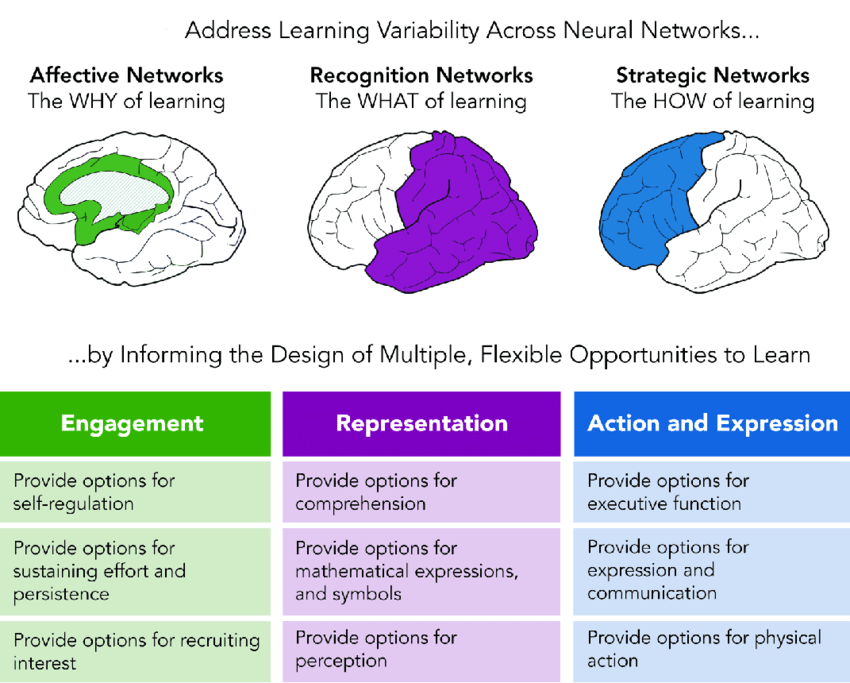
Barriers to learning exist in a wide swath of the population at different times and in different environments. Barriers to learning can be physical and mental, social and medical. CAST developed UDL guidelines that are based on three main principles that align with these learning networks.
UDL is defined as a framework to improve and optimize teaching and learning for all people based on scientific insight into how people learn. A teaching design approach that aims to eliminate barriers to learning so that all students will thrive. A great example of this is posting lesson goals for all the students to see in the classroom. Then, they can discuss this goal with the class at the beginning of the lesson and write it out in a visible place for the whole class to see. So, when hearing the term universal design for learning(or UDL), it makes sense to imagine it as a blanket format that covers all students.
Universal Design for Learning (UDL) is an approach to teaching and learning that gives all students equal opportunity to succeed. Phuong and Berkeley, using a randomized controlled trial, found that AEP, which is based on UDL, led to a significant improvement in students’ grades, even when several confounding variables were controlled for. The chart below includes the three UDL principles adapted from CAST. It also gives you some questions to consider and lists some examples of the principles in action. You can print a one-page version of this chart to have on hand while planning a lesson, activity, or routine for your students. You could share a mini-lesson on butterfly metamorphosis and have students use a guided worksheet as they write.
Universal Design for Learning (UDL) is a framework to improve and optimize teaching and learning for all people based on scientific insights into how humans learn. There’s a lot of uncertainty around the future of work and our world. The ultimate goal of UDL is to develop “expert learners” who are purposeful and motivated, resourceful and knowledgeable, and strategic and goal-directed. I won’t pretend it’s easy, but it’s crucial to commit to the UDL mindset in order to have success. Embracing the following four beliefs is the first step in designing learning experiences that serve all students.
By now, teachers should be aware of which students learn better through audio descriptions, which students have specific interests or which students require a particular learning process. It also may be helpful for teachers to take note of which students excel when using certain formats, or even to involve parents in helping find their children’s strengths and weaknesses in learning. This principle encompasses the ideas of motivation, building on the interests of the students. The area of engagement also helps students to see the reasons why they should learn what they’re learning, and makes it relevant to their life. Ultimately, UDL can be defined as a teaching method that aims to make learning accessible to every student's individual needs, regardless of the challenges and barriers they may face. In everyday life, we constantly run into examples of universal design.


No comments:
Post a Comment